
How FPL Player Price Changes Work
Fantasy Premier League (FPL) has a mechanic that essentially operates much like a real-world stock market, driven by the principles of supply and demand. Player prices are not determined by their performance alone, but rather by their popularity among the millions of FPL managers, a player being heavily bought can lead to a price rise, and vice versa a price fall for sales.
-
Price Rises: When a player is "in-demand" and heavily transferred into FPL squads, their price will increase.
-
Price Falls: Conversely, when a player is "out-of-favor" and heavily sold by managers (often due to injury, poor form, or tough fixtures), their price will decrease.
The exact algorithm for these changes is kept secret by FPL, but it's widely believed to be based on the number of "net transfers" – the total transfers in minus the total transfers out – for a given player. The required number of net transfers for a price change can vary from player to player based on ownership (a player with 1 million owners needs significantly more transfers to shift in price compared to a player with 1,000 owners).
The Mechanics of Change
-
Daily Fluctuations: Player prices can change once a day, typically 2:30am BST.
-
Incremental Shifts: Each price change is always £0.1m, either up or down.
-
Gameweek Cap: A player's price can rise or fall by a maximum of £0.3m within a single Gameweek.
-
Gameweek changes: If a player has already risen before the next deadline they will need a multitude more transfers for another change to happen
-
Flags: If a player is flagged (yellow/orange/red flag) this can affect the transfers required for a price change. If a player goes directly from a red flag to no flag their price is locked for 1 week.
While the majority of players will not experience a price change on any given day, monitoring these movements is a popular tactic for engaged FPL managers.
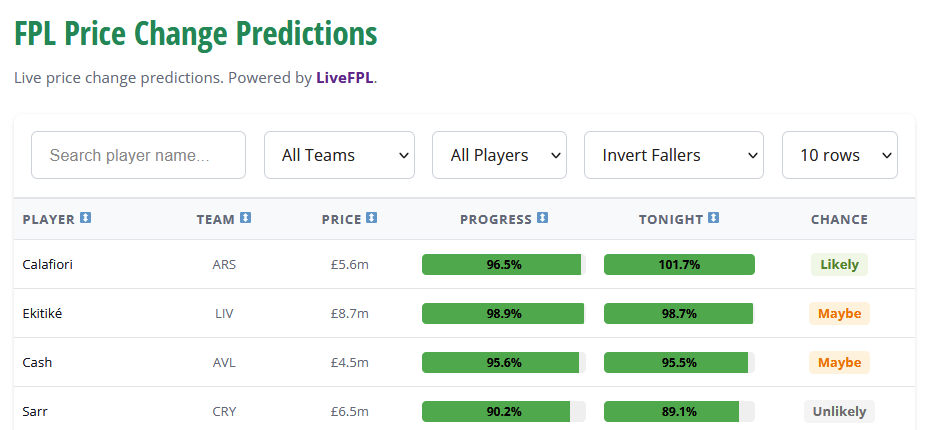
Price changes can be monitored on LiveFPL and Fantasy Football Scout. Those two are the most reliable predictors (based on WhatTheF.PL's tracking), and are the same on both sites, just presented slightly differently.
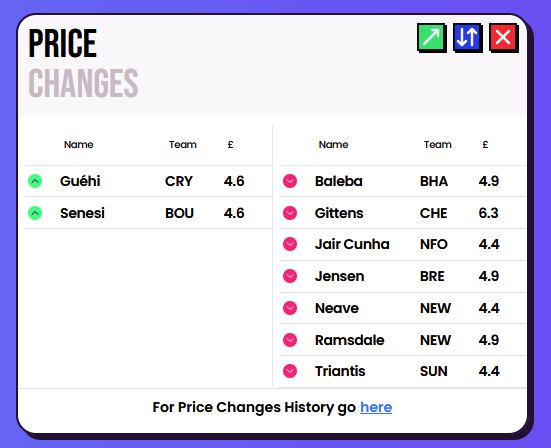
On fpl.page you can track price changes after they occur.
The Impact on Your Team
Price changes have a direct and significant impact on your FPL squad and budget.
-
Profit is Capped: If a player you own increases in value, you do not receive the full profit upon selling them. For every £0.2m the player's price rises while they are in your team, you can sell them for a profit of £0.1m. This means the FPL "bank" keeps half of the profit. For example, if you buy a player for £5.0m and their price rises to £5.2m, their selling price for you would be £5.1m.
-
Losses are Full: If a player's price decreases, you take the full loss. If you bought a player for £5.0m and their price falls to £4.9m, you can only sell them for £4.9m.
-
Building Team Value: Most managers use price changes to build their team value throughout the season, though ultimately points over team value matters most. Logically, picking good players leads to an increase in team value - easier said than done! A higher team value gives you more flexibility and a potential advantage especially later in the season.
Strategic Considerations
Knowing how price changes work allows for more strategic FPL management:
-
The Early Transfer: Making a transfer early in the Gameweek can be a gamble, but it's a popular way to "chase a price rise" or "avoid a price drop." If you transfer in a player before their price increases, you get them at a cheaper rate. Likewise, selling a player before their price falls protects your team value. However, this carries the risk of a new injury or a poor midweek performance by your target player.
-
The Wildcard: The Wildcard chip is a powerful tool for capitalizing on price changes. You can use it to sell players who are likely to fall and bring in players who are likely to rise, even if you don't intend to keep them, to maximise your team's value before the Gameweek deadline.
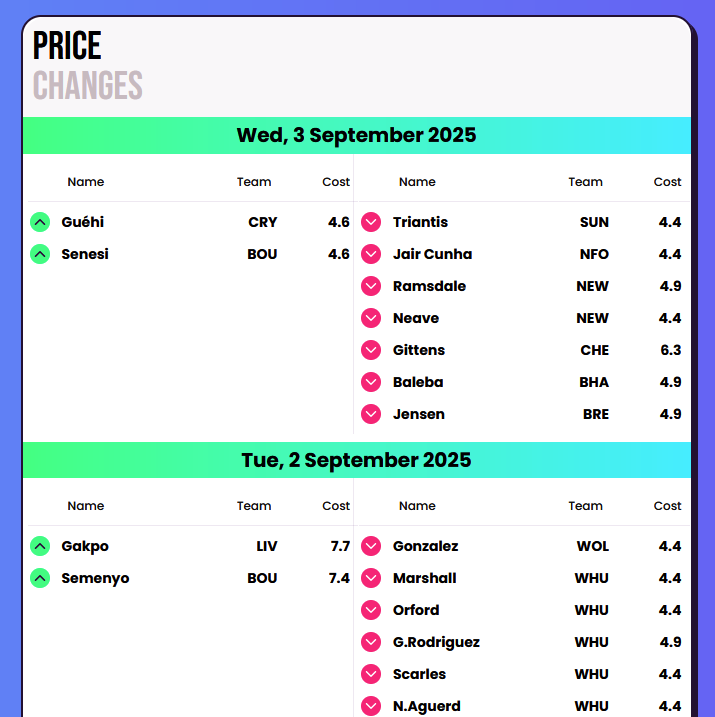
You can also view historic price changes here.
While the FPL price change algorithm remains a closely guarded secret, the underlying principles are clear. It's a system designed to reward active managers who stay on top of transfer trends and use this information to their advantage. Ignoring player price changes will lead to having your budget squeezed as the season progresses, but is not a guarantee of scoring better or worse necessarily. Some managers make their transfers minutes before the deadline to have the most possible up to date information at their disposal, which can be more valuable than catching 0.1m days prior.